 The Blueprint of Icarus (explainer video)
Glossary of Key Terms
| Term / Entity | Definition |
| AI (Artificial Intelligence) | Portrayed as a linear, digital, and mathematical system that can summarize text and perform tasks but lacks a soul, backstory, or genuine understanding of human emotion and consciousness. It is often used as a philosophical counterpoint to humanity’s spiritual nature. |
| Chupacabra | A recurring nickname the author uses for his son, particularly when describing his son’s more troubling, elusive, or destructive behaviors. |
| Cold Plunge | An immersion in cold water that the author practices. It is described as a “tonic” with an immediate and shocking effect, used as a way to reboot the body’s systems and achieve a state of euphoria similar to a runner’s high. |
| Confluence | Defined as the flowing together of two or more streams. The author uses this metaphorically to describe moments where disparate events, memories, and thoughts intersect in his life, creating a “combined stream.” |
| Hyperfiction | The author’s term for his work, characterized by non-linear associations, multimedia elements, and an interactive style that allows readers to navigate concepts of recovery, avoidance, and renewal in a fragmented way. |
| John McElhenney | The author and first-person narrator of the texts. He is a writer working survival jobs (cashier, Apple Store) while navigating complex family crises involving his son’s addiction and his relationships with his daughter and ex-wife. |
| Project 2026 | The author’s proposed plan for the future, centered on “Humanism, humanism, planetary health, the big blue marble party.” Its goals include “rebooting nuclear power and shutting down wind and solar projects.” |
| Sid and Hunter | The author’s two cats. They are frequently used as an analogy for his children, representing their independent natures, their capacity for causing trouble, and the author’s limited ability to control them. |
| The Daughter | The author’s daughter. She is depicted as emotionally distant, ashamed of her brother’s actions, and employing her own coping mechanisms, often by creating distance from the family’s problems. |
| The Ex-Wife | The mother of the author’s children. Throughout the texts, she is portrayed as having low emotional availability, deflecting responsibility for their son’s issues, and often being uncooperative or unresponsive to the author’s concerns. |
| The River | A central metaphor for the flow of life and the necessity of patience. The author learns that one cannot force or “push the river” but must instead align with its currents, observe, and wait for the right moment to act. |
| The Son | The author’s 25-year-old son, who is the primary focus of many essays. He is characterized by his struggles with drug addiction, mental health issues, unemployment, erratic behavior, and a fascination with guns. |
| The Third Thing | The essential element that sustains a relationship beyond initial passion. It is defined not as one thing, but as a “multiple of little connections, little highlights, nano-joys” and a continuous discovery of one’s partner. |
| TimeQuake | A concept borrowed from Kurt Vonnegut. It refers to a “time rebooted” event that broke the “infinity loop” for people who were stuck, forcing them to relive a period of time. |
Quiz: Short-Answer Questions
Instructions: Answer the following questions in two to three sentences, drawing exclusively from the provided source materials.
- What is “Project 2026,” and what are its primary stated goals?
- Describe the central metaphor in the piece “Again, To Let Go” and how the author applies it to his personal philosophy.
- What are the “three pillars of hyperconsciousness” as identified in “Break Your Time In Mind”?
- Summarize the author’s main concerns regarding his son’s behavior and state of being, as detailed across the collection.
- How does the author distinguish between human consciousness and Artificial Intelligence in his writings?
- According to the essay “The Third Thing,” what is the essential element required to sustain a long-term relationship?
- What two specific, non-negotiable requests does the author make concerning his son in “Fading Light”?
- Based on the texts, describe the author’s professional life and financial situation.
- According to “Fierce Intelligence,” what is the underlying reason billionaires are building massive survival bunkers?
- Explain the analogy the author draws between his two cats, Sid and Hunter, and his two children.
——————————————————————————–
Answer Key
- What is “Project 2026,” and what are its primary stated goals? Project 2026 is a plan the author introduces that encompasses “Humanism, humanism, planetary health, the big blue marble party.” Its stated goals are to welcome all of humanity’s projects and to reboot essential systems by “rebooting nuclear power and shutting down wind and solar projects.”
- Describe the central metaphor in the piece “Again, To Let Go” and how the author applies it to his personal philosophy. The central metaphor is that of a river, which represents the natural flow of life. The author learns that any attempt to “push the river” or force events is futile; instead, one must learn patience, align with the current, and sometimes simply “stay beside the stream. Observe. Listen. Wait.”
- What are the “three pillars of hyperconsciousness” as identified in “Break Your Time In Mind”? The three pillars of hyperconsciousness are identified as love, joy, and peace. The author notes that these can be applied to the “threads of god” and suggests they are key to understanding a nonlinear principle of time.
- Summarize the author’s main concerns regarding his son’s behavior and state of being, as detailed across the collection. The author is deeply concerned about his son’s drug use, addiction, and lack of direction. He is also alarmed by his son’s fascination with and possession of numerous guns, his erratic behavior (like wandering the neighborhood at night), and his inability to hold a job or establish independence.
- How does the author distinguish between human consciousness and Artificial Intelligence in his writings? The author portrays AI as digital, mathematical, and linear, lacking a soul, backstory, or genuine understanding of human emotion. In contrast, human consciousness is described as spiritual, connected, and capable of processing complex, non-linear thoughts and feelings that AI cannot comprehend.
- According to the essay “The Third Thing,” what is the essential element required to sustain a long-term relationship? The “third thing” is the magic that holds a relationship together after the initial passion fades. It is not a single thing but rather “a multiple of little connections, little highlights, nano-joys” and the ongoing, continuous discovery of small things about one’s partner.
- What two specific, non-negotiable requests does the author make concerning his son in “Fading Light”? The author makes two requests regarding his son. The first is for “no loaded weapons in the house, 100%,” and the second is for his son to find another place to live, as he is an “abused my empathetic parent.”
- Based on the texts, describe the author’s professional life and financial situation. The author works as a cashier at a corporate organic grocery store, a job he refers to as his “survival job.” He also works at an Apple Store. He appears to have financial worries, mentioning the need to take on a 60-hour-a-week job at a grocery store and expressing that he cannot afford to take vacations.
- According to “Fierce Intelligence,” what is the underlying reason billionaires are building massive survival bunkers? The billionaires build bunkers because they prioritize “individualistic survival and control” over collective prosperity. They fear losing control, privilege, and security more than they trust in a “truly equitable world,” choosing isolation over sharing power and resources.
- Explain the analogy the author draws between his two cats, Sid and Hunter, and his two children. The author compares the independent and sometimes destructive nature of his cats to his children. He notes that the cats, like his children, have their “own agenda” and that he provides safety and warmth but cannot control their choices, recognizing his own “malfunctions” in their behavior.
——————————————————————————–
Essay Questions
Instructions: The following questions are designed for deeper reflection on the core themes of the texts. Answers are not provided.
- Analyze the recurring theme of “letting go” versus taking action in the author’s relationship with his son. Use specific examples from at least three different excerpts to illustrate this internal conflict.
- Discuss the author’s exploration of time, memory, and consciousness. How do his references to writers like Kurt Vonnegut and concepts like “TimeQuake” and “hyperfiction” contribute to this central theme?
- Examine the role of water—in the form of hot tubs, cold plunges, and the river—as a powerful and recurring symbol for emotional, psychological, and spiritual states throughout the collection.
- Compare and contrast the author’s portrayal of his own father’s struggles with alcoholism and destructive behavior with his son’s present situation. What parallels and differences does the author explicitly or implicitly draw?
- Trace the author’s evolving relationship with spirituality, God, and faith. How does he reconcile his personal, mystical beliefs with traditional Christian doctrine and his interactions with his “Jesus mentor”?
back to > Icarus Ascending Index
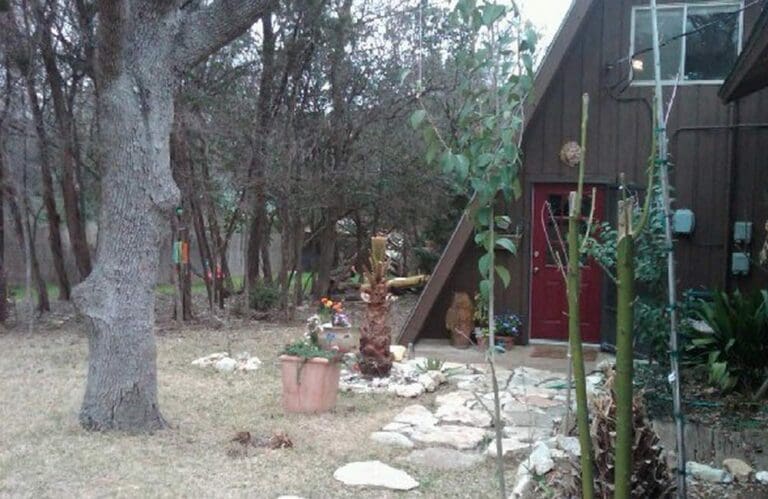
note: image is of my first post-divorce house, the gnome house, October 2014
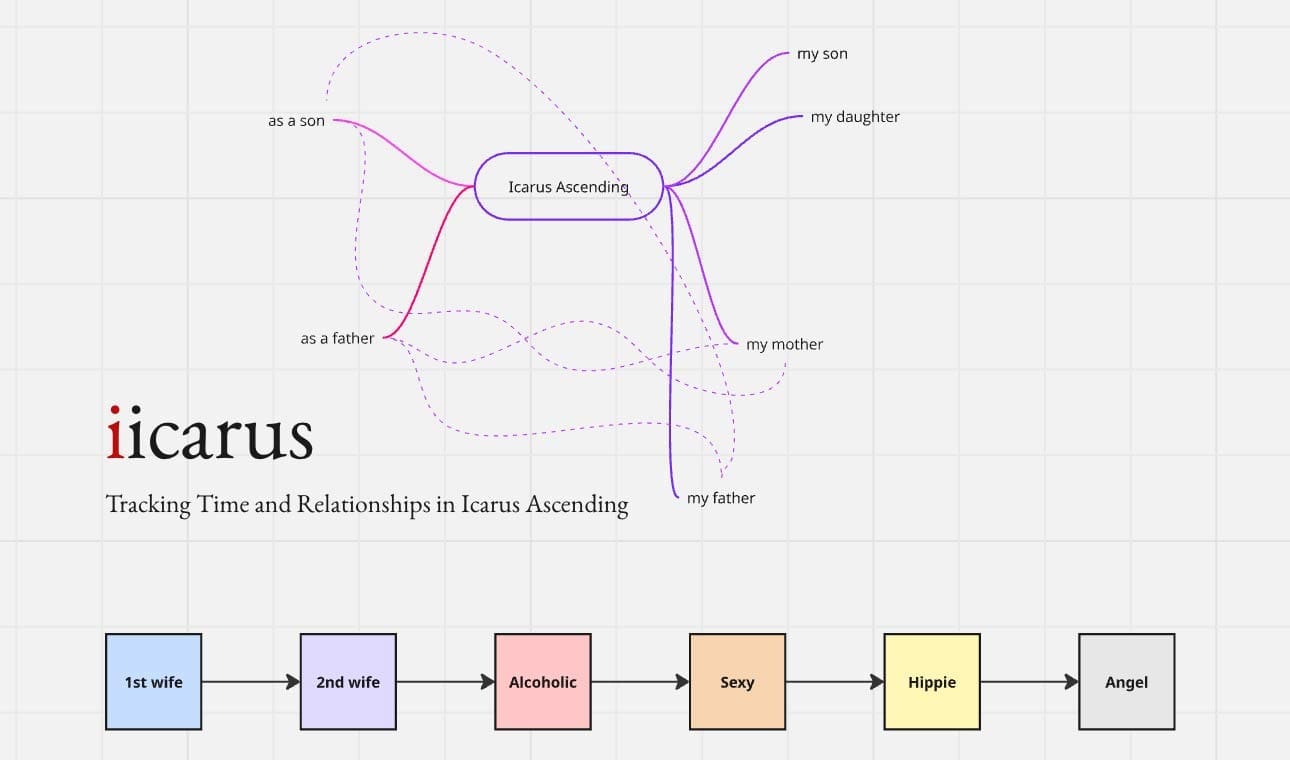
For readers new to hyperfiction: see this explainer video: Blueprint Of Icarus Ascending