In 1965, Henry Miller was already winding down or perking up. His prose purple with penises and pussies, he would be known as the literate pornographer. Like D. H. Lawrence before him, and Lawrence Durrell with his companionable spirit of swift and energetic prose, untethered from traditional writing, traditional flow. A book of correspondence between the two of these great men of letters and syntax brought a lot of clarity to my mind in thinking about writing. Encouraging other writers while I am encouraging myself. Learning that those two efforts are closely entwined. Read great works. Write better works yourself.
“Jump off,” Miller exclaimed to Durrell. “You are a protected individual.” He was pushing Durrell to take the position on the Island of Corfu, where his writing would warp into a darker more personal rant. His wife would lose her mind and begin to cause trouble for everyone nearby. Miller understood and sympathized with this progression. They were locked in a mutual appreciation for the jagged prose of sex, power, persuasion, and loss, encouraging the explosion of both of their streams of consciousness.
By the time Miller was writing Sexus (the start of his Rosy Crucifixion series) he had found his flow. The two men continued their friendship, encouragments, and writing experiments on until their late years. Miller found his stride with Tropic of Cancer. The second book of his coming of letters. Durrell and Miller exploded into transformational prose/fiction/memoir/narrative voice together. Their books became entwined only if you knew the story, found the book of letters in a San Francisco rare books shop. Many years later, replacing the copy of the book of letters, used from Thrift Books.
A passage I just sent to a friend-poet, David,
“Swung out of my accustomed orbit, I nevertheless had sufficient balance to observe my bearings. The way I now saw things was the way I would write about them one day. Immediately questions assailed me, like slings and darts from angry gods. Would I remember? Would I be able, on a sheet of paper, to exfoliate in all directions at once? Was it the purpose of art to stagger from fit to fit, leaving a bloody hemorrhage in one’s wake? Was one merely to report the “dictation”—like a faithful chela obeying the telepathic behest of his Master? Did creation begin, as with the earth itself, in the fiery bubble of inchoate magma, or was it necessary that the crust first cool?”
Excerpt From: Miller, Henry. “Sexus.” Grove/Atlantic, Inc., 1965
I was three years old. It would take me until after college to discover Tropic of Cancer. “This is a spit in the face of literature.” (my paraphrase) And before I found Fear and Loathing, I dropped into Miller’s miasma. I am only now reading this later bigger bolder more poetic book. The first of three. Big heaping bowls of mixed and made-up metaphors and similes with no “like” or “as” and full of “what the fucks?”
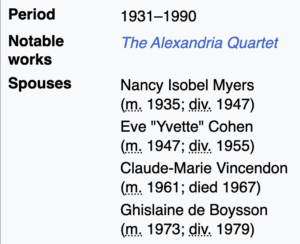
Durrell’s The Black Book became his response to Miller’s Cancer. And we’re off to the races. Durrell’s Alexandria Quartet is so beautiful and filled with questing for the holy spirit of prose, that I was a little dismayed to see that his younger brother, the one the PBS TV series was based on, Gerald Durrell, is now the more famous Durrell. Google it, see what you find. I need to read the rescue zoo guy. The TV show was a favorite of my mother. We watched a number of episodes together during one of my residencies of repose. Mom’s house in my fifties, her in her eighties, we made the most of it. Clashed occasionally. I look back on that time as some exquisite time just being with and understanding, listening to, and encouraging my mom. The mom who gave me reading, writing, and artistic drive.
She would complain about how hard “making art” was for her. She lacked the contextual self-reflection to see it was the trauma that was hard and the painting that was the release. She began to talk of how difficult it was to be a painter. Hmm?
Later, after she sold the lake house and moved to central Austin, I encouraged her to resume her painting. She complained. I think it was hard for her to stand. She compromised and worked on smaller 3 x 3 foot canvases. She had painted 5 x 5 and 3 x 6 paintings. Even a connected triptych of massive squares mounted like diamonds across the back wall of her opulent living room overlooking the primitive Lake Austin of the 60s. The house is still on the market for 27 million dollars. What a trip it was to visit as a potential buyer, with my sister and her realtor. We just wanted to look.
I had gone to high school with the two children of the family who purchased the house from my mom, as we were both making our escape from my dad’s toxic orbit. Me to Exeter in New Hampshire, her in NYC to join her emerging-artist daughter with a walkup flat on Bowery and Houston. Seriously. My mom’s place was on 72nd, one block from Central Park and easy walking distance to FAO Swartz, where she worked the only “job” in her life over one Christmas. She didn’t need the money; she needed purpose and community. She had my sister and her boyfriend, also a painter and a sculptor.
What privilege is required for both of them to paint, screw, and blossom in New York City, a floor above William Wegman’s Man Ray period? Katy, the dog she gifted me and had to take back, met and played with Man Ray in the rat-swarming streets of Wall Street after dark. Katy was ferocious. And like all Golden Retrievers, she loved to fish in small lakes. I don’t think she ever caught a minnow, but she hunted them with passion and precision.
I, too, am hunting for my voice, my crack in literature. I have a gadfly and supporter, but he’s not doing well. A poet with books in City Lights Books. Mine are available on Amazon. I need to get them to some other platform, no more money for the bloodsucking billionaires. But it will take time.
All I have is time. Time that I exchange for money, for love, for food and shelter. I’m doing a fair to middlin job on that one. Looking up this week, however, as two new contracts have emerged. I made more last week (when they pay me) than I made in a month working as a “happy” cashier at Whole Foods Market. (An Amazon cluster fk)
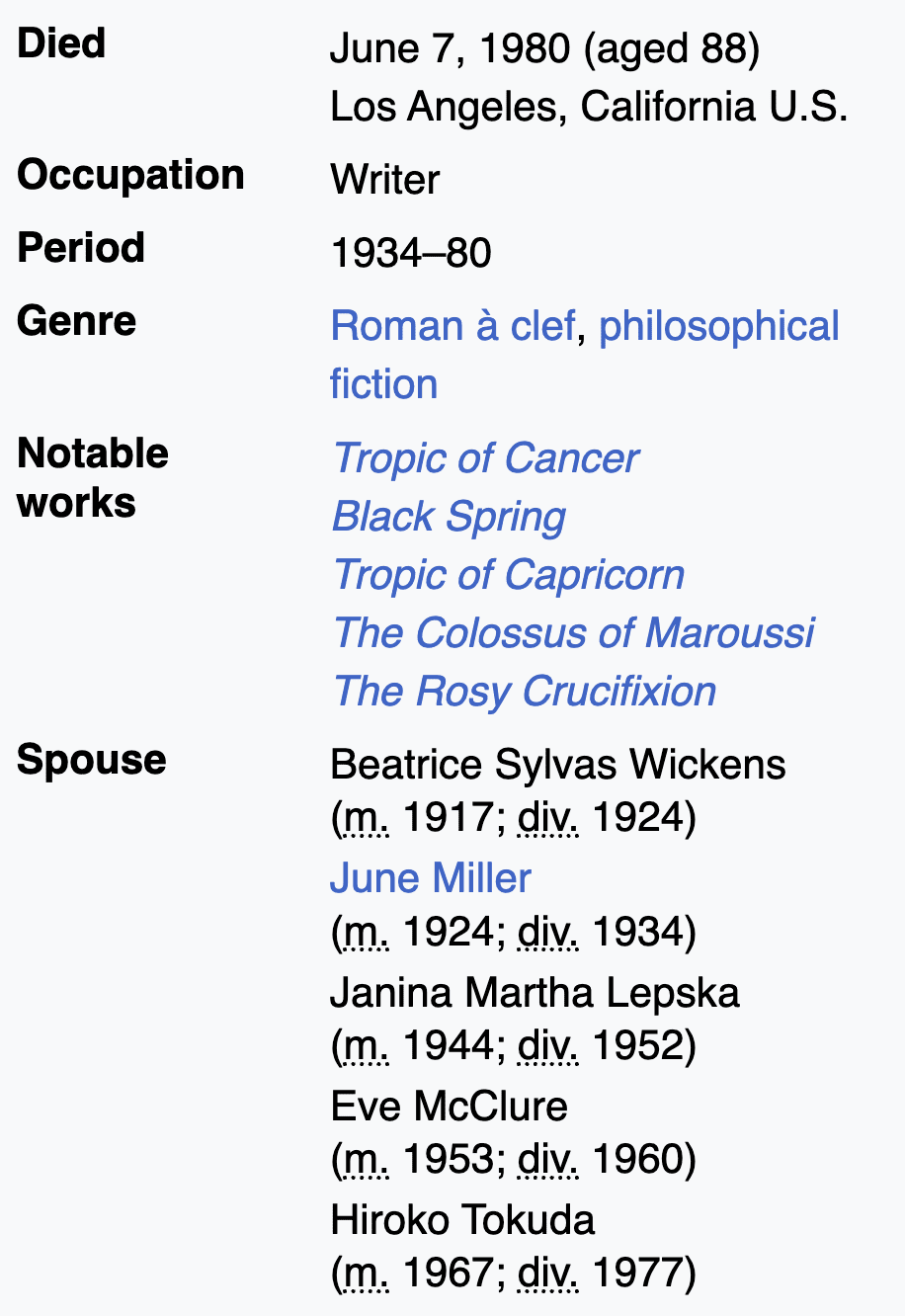
So, here we are, writing and reading together. In my metaverse, Henry Miller is able to hover and enjoy my reading of Sexus. I’m not sure what form he is in, but I feel his energy and encouragement when I read is going-flowing prose. And their rap sheets tell similar stories of unrest and love troubles. Writers are hard to please. And when they are done with you, they can write mean things about you.
Writers are hard partners. You never know if we’re writing the experience in our minds or just recording it. Writing about our friends and family. Flattering poetry is nice. Raw unexpergated narrative is weaponizing toxic masculinity. Really? No. I do not believe that.
I am not the victim. I am also not Machiavellian in my aim and ambition. I do want to sell more books, but it’s not to be famous. (I think I courted that idea in my 30s, 40s, 50s) I like my private life. I write to organize my thoughts. Some of those thoughts are less wholesome than others. People don’t like hearing their own words in print. When it makes them look bad, well, the writer of the story is the one who gets to make up the scene and setting. An unreliable narrator is a device. An unhinged narrator, like Kerouac and Thompson, is a different form of this classic trope.
People don’t like it when you write about them if the story is accurate but not sweet. My ex-wife has lost her mind more than once on my “divorce” stories. Um, okay… People write about divorce. I wrote to survive, to solve for “what the fuck went wrong,” and what do I want to do next?
Many people do not like Henry Miller and his sexual exploitations in words and sounds. He was a master at doing his rant. Sexus and the following books were his follow-up to the Tropics and his eventual liberation from “day job” struggles. Anaïs Nin, in Paris, also provided much-needed cash, food, and comfort. Henry and June, the movie, was written using her diaries as the source. Her diaries.
Please read Nin’s diaries. You will be amazed at how much she gave to literature by publishing them. The coming of age of a modern and brilliant woman via her journals. Wow.
When you find a vein that feeds and feels parts of yourself, you must dive in. You must take the tangent. Got for the rip-roaring fun. You must.
No one reads boring books. A nice book is going to be overlooked. What’s the last “nice book” you’ve read? I’m not writing nice books. Nor YA books. I’m setting a course for my own spasm of speech mixed with clickity clicking, and leaving behind a wake of words, some of them poison-tipped and pointed at the ones I love, loved, or am loving. Ooops.
Okay, so pay attention. What are you reading? How is it informing your writing? Stop watching TV and movies to pass the time. Time is fleeting. Use your time to refine your conversations with yourself. You are the best reader. How does it sit? How does it make you feel when you write it? The writer gets to tell the story however they want. No one will read it anyway. So, why publish it?
A bigger question looms…
< back to the Untethering index
Here is the Cloud Pilots episode explaining this chapter.
The podcast of artistic resistance to AI.