There has to be a limit, right?
Seeing the light go out of your partner’s eyes is terrifying. Asking for clarification. Asking for their return. Apologizing for any and all things you think “might” have upset them. All good ideas.
When the recoiling partner can’t see you or respond from their heart, it is time to take a break. This can sound like, “I need 5 minutes and I will come back and discuss this with you.”
They might say:
- you are angry
- your face shows that you are angry
- your body language says that you are angry
- your tone of voice says that you are angry
Countering this monologue is counterproductive. It is better to step aside and let the storm rage where it belongs.
I am sad. I am anxious. Not mad. I don’t know how to make my face, my body language, or my tone to make you feel safe. It is my job to manage my own communications, my own actions, and my own boundaries. When you say, “You’re trying to make me feel guilty,” there is little or no truth or value in the statement. Here’s why.
I am expressing myself. Taking responsibility for my actions. Asking to be seen for what I have said, what I am saying, and how I am behaving. I cannot counteract all the objections. But they are not proper objections. They are projections.
“I am feeling sad and a little bit anxious.”
“You are trying to control me. Make me conform to some system or plan that you have. I don’t want a system. I don’t want a strategy. I don’t need a process. I need you to hear me.”
Back up the chain of conflict communication skills. Reflect. “I hear that my face, my body language, my tone of voice, and my words are having an effect on your body and self-regulatory system.”
“You are trying to make me feel…”
Stop. No. You are not that powerful or precient. You cannot tell me what I am thinking at any given moment. You can say, “Your expression makes you appear mad, to me.”
To me, is the important part.
“How can I change my facial expressions to make you feel less criticized or attacked?”
“Now, you’re trying to say it’s all my fault.”
No. Stop.
“I am here, trying to connect with you. What I am observing in your behavior and words is you have disconnected from this moment.”
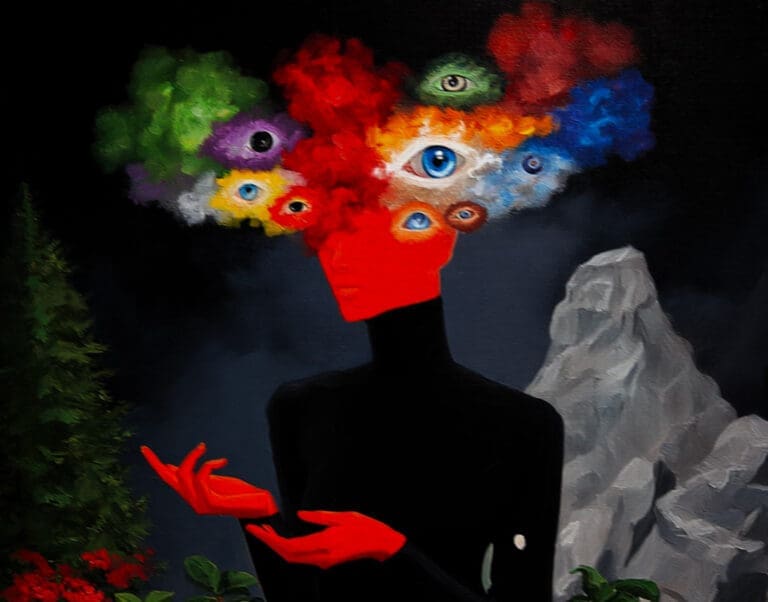
The eyes have it. When your partner can’t look you in the eyes, it is time to be quiet and listen. Even if they ask to hash it out, work through the interruption, it is ill-advised until they have returned to the present moment. Often, the only way back is through.
Caught in a fog of something else, a past hurt or fearing of some hurtful future in our timeline, a partner cannot simply stand in and be a good listener.
I red a story from Reshad Feild that has been haunting my mind over the last few weeks of glitching.
In this Sufi tale, a beautiful young woman walks around with a tangled mess of blue yarn. At times, she is trying to unravel the yarn. Othertimes, it appears the yarn is more like restraints around her hands, preventing her from reaching out or receiving any support from those around her.
Hamid is the spiritual teacher in the book, The Last Barrier. He says these lines to the protagonist of the book.
In her yearning to be recognized, and thus be freed, she went to teachers in many different countries around the world, in her eagerness, she lost touch with her essential self, and has not been able to find the path again.
When the girl comes to you with the wool wrapped round her wrists, like an imprisoned animal, she is begging you to see her, begging you to understand and free her through recognition and understanding.
It is almost as if the girl has been sent to us as a messenger, a continuous reminder of our responsiblity in being born man and woman–the responsibility of finding our true stel so that we may play our part in bringing others into that great freedom.
I knew the girl with her blue ball of wool was not just another sad creature, unable to care for herself, but that she represented something far greater than I had yet been able to realize.”
Even if, the girl with the blue yarn is the most amazing and beautiful person we’ve ever met, we cannot heal what is not ours to heal. We should have already learned the lesson that it is not okay to stand in for the abuser or hurtful memories she is reliving when her eyes glaze over.
In a moment of clarity, I asked, “Isn’t this just the exact scenario you said I should just hold you for a bit? No words. Just holding?”
“I think you should take all of your things, yourself, and get out of my house. You are angry and hurting me, and I’m not interested in being hurt anymore.”
“Okay…”
I release you. I apologize for my negligence in giving you the time and space to feel the aloneness. To establish your own routines alone. I will return when asked. Until then I will sit with my own ball of wool and my own sadness. I am not alone. I am no longer with you.
We all have our own balls of blue yarn. When a partner says you are trying to make me feel… It’s okay to stop them. When they say your facial expression is showing my how angry you are. It’s okay to recognize that the anger is coming out in painful darts. It is not a good idea and stand in for the mean or abusive person. The poison from the darts will cloud your own mind, prevent you from being a good and safe partner. When they try and tell you what you are thinking, or what your words mean about your state of mind, again, they are mindreading you. She is not a mindreader. She is projecting her hurt and fear onto you. Nope.
Stopping the drama cycle requires both partners taking responsibility for their clear words, their clear actions. They must stop telling you what you are thinking. Telling you that you were trying to shame them or damage them.
No, I was sad.
When there is one person trying to hold the peace it may be enough for a little while. The hurt or recovering person must take their own action, their own process, time, and recovery for them to regain clarity.
I jumped to lightspeed. I refused to accept the red flags that were lit on fire before me.
I’m a better man.
I am not a better man.
I was asked to take my shit and go. So, I honored the request. I apologized for my inattention. I did not think that is what the issue was. I was asked to go back into my corner of the world and give her time to sort, weave, and find the beautiful flower she was going to knit with the blue wool yarn.
I ask for a prayer of peace for her. I will be fine.
Against my own better judgement I tried to help her with the blue yarn ball. I stood in for her ex, I tried to be centered, use some processes for containing rage and hurtful communications. I failed.
What I failed was myself.
I am back in the sad pause of awareness. “She is not ready. She has many roads to travel alone at this time of turmoil and change. I cannot heal, coach, or love her back to wholeness. She has to find her own peace. Her own morning routines. Secure her own space. Reconnect with her own tribe of people.
Without my influence.
I overstepped my own boundaries. Attempting to wipe away the interruptions with pauses, reflections, good listening, and my own inner peace. I am no longer peaceful. I’m sad.
When I tried to give her my own status, my own self-reported feelings and actions, she said I was not telling the truth. That I was missing her point. That I wasn’t listening. I have been listening. Probably too much.
A year ago, I went to an Al-Anon Parents of Addicts Meeting as I was orienting myself to my son’s affliction.
The reading that night had a very clear message.
“You are probably already doing too much.”
Namasté, sweet and chirpy wren. I hope we find a reset point, but I’m going back out into the sun.
In the final few minutes of our conversation today, I was giving her a few scheduling updates from my morning of reflection and connection. Perhaps she was feeling something about her own tribal loss. She did mention how “our time” had caused her to lose “her time.”
Okay.
I give you back your time.
(sad face)

back to the glitching index