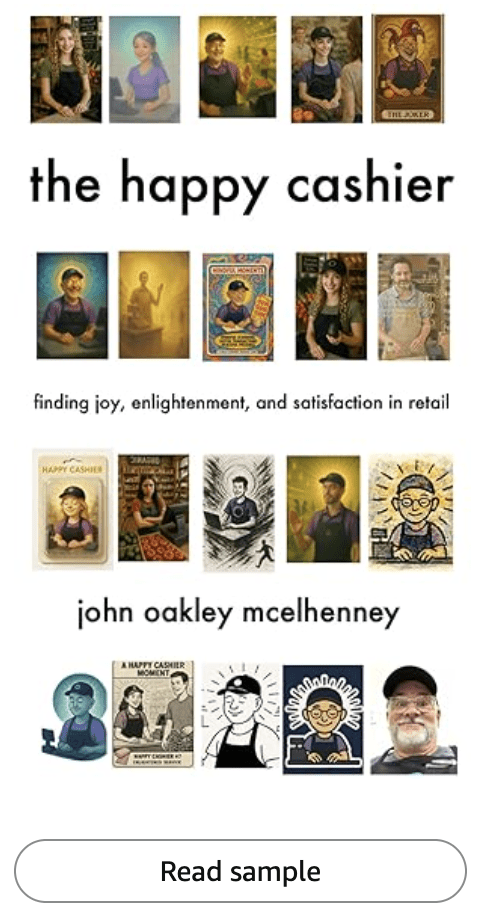
The Happy Cashier is a podcast and writing project by John Oakley McElhenney about his time working as a cashier at Whole Foods Market after a major personal and professional shift. The project frames retail work as a place for mindfulness, recovery, compassion, and human connection. The episodes and related material focus on presence, gratitude, and learning from ordinary customer interactions.

Overview
The project centers on McElhenney’s experience returning to customer-facing retail after earlier work in corporate and creative fields, including writing and coaching. His time as a cashier is presented as part of recovery from depression, with a strong emphasis on acceptance, gratitude, and service. The larger idea is that ordinary work can become meaningful when approached with attention and care.
Summary
The main themes are simple but important: stay present, treat customers as people, and use repetitive work as a chance to practice patience. The podcast often reflects on anger, resilience, and the search for meaning in small moments. For retail workers, the message is that attitude matters as much as speed or accuracy.
Wisdom of the Happy Cashier
John Oakley McElhenney’s The Happy Cashier offers an uncommon look at retail work. Instead of presenting cashiering as tedious or invisible, he turns it into a place of observation, recovery, and even growth. In the podcast and related writings, he describes working at Whole Foods Market after a difficult life transition, and he uses that experience to explore what it means to show up with patience and purpose.
One of the strongest ideas in the series is that retail work is deeply human. Every customer who comes through the line brings a mood, a need, or a story. A cashier cannot control all of that, but they can control the tone of the interaction. McElhenney’s approach suggests that being calm, courteous, and attentive can turn a routine transaction into a small moment of dignity for both people.
Another valuable lesson is that repetitive work can still be meaningful. Retail often asks workers to do the same tasks again and again, yet the podcast frames that repetition as a chance to build awareness. The same greeting, scan, bag, and goodbye become opportunities to practice consistency and kindness. That mindset can make hard shifts feel less draining and more intentional.
The project also offers practical advice for retail workers. First, do not underestimate the value of a steady emotional presence; customers remember how you made them feel. Second, protect your energy by not taking every rude interaction personally. Third, look for small wins in the day, because those moments add up and help sustain morale.
What makes The Happy Cashier stand out is its honesty. It does not pretend retail is easy, but it refuses to see it as meaningless. That perspective is useful for anyone in customer service, especially workers who need encouragement to stay grounded during busy, frustrating shifts. The larger message is clear: good service is not just about efficiency. It is also about empathy, self-control, and finding dignity in everyday labor.
Concrete mindfulness exercises
Work-friendly practices like breathing awareness, the 5-4-3-2-1 senses exercise, and brief pauses to notice the present moment. They also suggest mindfulness during everyday tasks, such as brushing teeth mindfully, paying attention while riding an elevator, and walking while noticing trees, sunlight, and bodily sensations.
Exercises Mentioned
-
Breath focus: sit briefly and notice the rise and fall of the chest, the air moving in and out, and the moment when the mind wanders before returning attention to the breath.
-
Mindful brushing: focus on the bristles, the bubbles, and the toothbrush buzzing instead of letting the mind drift to the next task.
-
Elevator pause: use the 10–45 seconds in an elevator to notice the buttons, breathing, and the fact that you are already moving toward your destination.
-
Mindful walking: notice trees, sunlight, and physical sensations while moving through space.youtube
-
5-4-3-2-1 grounding: identify things you can sense through sight, touch, hearing, smell, and taste to anchor attention in the present.
What They’re For
These exercises are presented as ways to train attention without judgment and to create a small pause before reacting. The emphasis is on starting small, keeping it brief, and practicing consistently rather than trying to meditate perfectly. In a retail setting, that makes them especially useful for staying calm with customers, coworkers, or stressful moments on the floor.
Best Fit For Retail
For retail workers, the most practical options are the quick ones: a single mindful breath before greeting a customer, the 5-4-3-2-1 grounding method during a break, or an elevator-style pause before returning to the register. Those methods are subtle, fast, and realistic during a shift.
Listen to the podcast for more illuminating details about surviving a retail job.
 the happy cashier index < previous post | next post >
ALT: Botisatva’s Bookshelf | The Happy Cashier Podcast