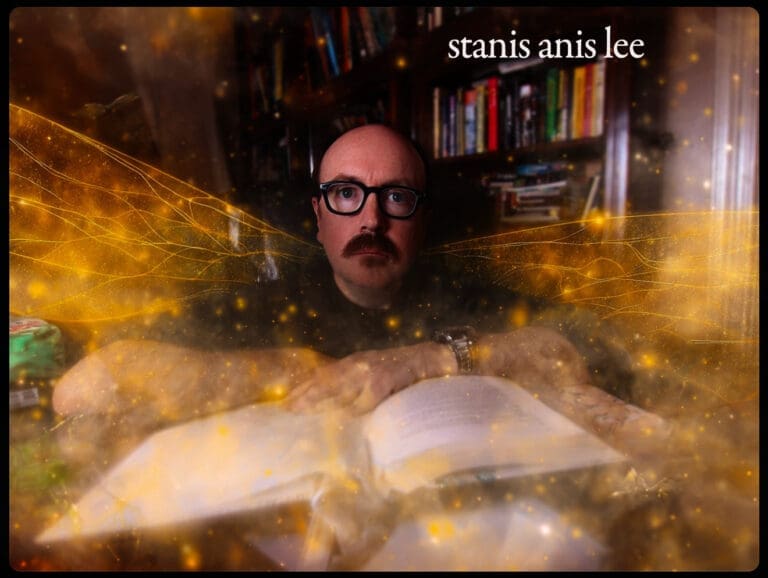
John Oakley McElhenney, when you encounter his digital presence for the first time, will come across as a wizard or court jester. The content of his writings ranges from self-help, dating, science fiction, and some novel experiments he’s calling #hyperfiction, hashtag included.
Here’s the thing, though, after you get over the “what the fuck” moment: Each of his rabbit holes is well-tended, well-imagined, and well-populated with characters and people you’d want to meet. Or hope not to meet, in the case of alcoholics or those with mental illness. Still, though all of his 63 years (though he looks and acts much younger), he has achieved a positive outlook on life. Optimism and hope run through even the darkest of McElhenney’s exposés.
The self-help and divorce stuff is different. But it’s also the same process. Living life, making sense of life, and trauma as a part of the creative process. Art hopes to capture the emotion of the moment, of the human, of the event. In the case of McElhenney’s first big work, The Whole Parent and The Off Parent blogs, John became untethered emotionally, and he suddenly had most of his nights and weekends back. His ex-wife reneged on their collaborative divorce plans and went for the “mom package.” She got the kids 70% of the time, she got a child support payment that would cover the house and health care for both kids. All she had to do was figure out how to make herself happy.
Poetry is a fun jumping off point for McElhenney, in his earliest work, you can see hints of the #hyperfiction cluster fuck about to happen.
A few days ago, I asked John about that phrase. Here is more of that interview. (previous excerpt at the end)
“a hyperfiction cluster fk”
It’s on his latest novel, just underway, called “Soul Love.”
SAL: So, what is this cluster fuck thing all about?
JMc: I’m glad you asked. It’s supposed to be a bit jarring. ‘Not for the faint of heart’ thing, I guess. Warning off the casual readers.
SAL: Is your work fucked up?
JMc: Intentionally, yes. Fucked up in terms of navigation, entry points, threads of inquirey. The entire hyperfiction idea came to me soon after HTML was introduced. I was working at a local ad shop, I even recall the first time I heard the phrase, “The World Wide Web.” Do you know where you were when you heard that?
SAL: No idea. Please continue.
JMc: I had just hired a lovely guy from The University of Texas to run our IT department. I was moonlighting at that job while holding down my graphic design workload as well. Ben was a lovely and gentle soul. He had dated a friend of mine, so I knew his heart was in the right place. We were on our way to celebrate his hiring, with real money, and driving in my convertible Rabbit to an Elvis Costello show at The Backyard, near Bee Caves. The music was jamming. We were sort of talking over the music and wind noise. “Yadda yadda yadda, the world wide web,” he said.
I nearly crashed the car. I turned down the music, slowed way down, and said, “What the fuck did you just say?”
SAL: And the cluster fuck?
JMc: Right, that. In my explorations of HTML and hyperlinked fiction, I ran into both technical and emotional hurdles. I didn’t believe. Today, I’m fully vested in the destruction of the traditional novel format, for something more modern, more connected, more ‘native.’ Can you write a novel on TikTok? Sure. Can I pull you into a story by sharing a music video with you? If an Instagram account is your scroll of choice, how do I get my writing, my ideas and stories, into your stream, into Instagram?
SAL: So, multi-channel writing?
JMc: Sort of. It’s a bit more organized. As I go along writing in this style, I am evolving and changing some of the ideas I started with. For example, at first, my maxim was “no ai” for any of my writing projects. Now, I’m still “anti-ai” but I’m using Grammarly, with the AI turned off. And I use Midjourney often to create illustrations for my writing.
I want to show up on your platform. If you’re a Facebook user, I am there. If you like Pinterest, I’ve got stories and pins for days. How you find me is less important than you did. And then, my challenge is how to get you to sit down for a visit with my writing.
SAL: You talk a lot about time travel in your hyperfiction work. Is there something about memory and time travel that we should know?
JMc: You’re leading me on. Yes, in fact, time is not relative; it’s one singular event happening all at once. Your human mind can only comprehend your “viewport on this reality of time” from your birth to your death. But the soul, the you in you, does not die. It doesn’t really reincarnate either. And, I’m most sorry to say, in my version of heaven, or the afterlife, it does not mean you’re going to be with your mom and dad or your favorite cat, Peter. Nope.
SAL: So your phrase that repeats, “I am here. You are here,” is more than just a mantra?
JMc: You’re correct, it’s a clue. It’s THE CLUE, actually, to understanding the human universe and our place in the macro-universe. How arrogant to imagine that we are the only sentient beings in all of the universe. Not likely. How silly of us to be destroying our planet in the name of becoming smarter and richer.
When time is continuous, then we have to look at the humans (living) within our viewport of time, and decide whether I am interested or am I repelled. Mostly, as humans, we only go for relationships that feel good. There are exceptions to this rule, of course.
SAL: So “I am here” means what?
JMc: That we, you and me, are sharing the same moment in our viewports of human time.
SAL: “You are here?”
JMc: If you’re reading me, if you’re listening to the sound of my voice through an audiobook, I am actually here with you as well. In a different form. But real, and simple, and important.
The concept: when you read my writing, my words become your thoughts. In my universe, if I’m no longer in my human form, I can travel to be beside you, to hear your chuckle of delight. I can hover nearby when you are reading my books.
SAL: Whoa. What are you saying?
JMc: The writing is the time machine. The words transport my thoughts, my voice, my ideas, to you, regardless of what timeline you are on. If you are reading my words, we are sharing a moment in “time” and the “space” part is a bit more abstract.
SAL: Got it. So what’s the one thing readers should know when they start diving into your hyperfiction universes?
JMc: Stay light-hearted. Don’t fight ambiguity or abstraction. A metaphor is a gateway, the rest of the enlightenment is up to you and your own explorations. My hyperfiction world is pushing readers to go deeper, critics, like yourself to go, “wow,” and hopefully, at some point, my bank account to recover from the red.
SAL: Thanks again for taking the time to explain time in the art of John Oakley McElhenney’s hyperfiction world.
JMc: That sounded like an outtro. Oh, thank you. Anytime.
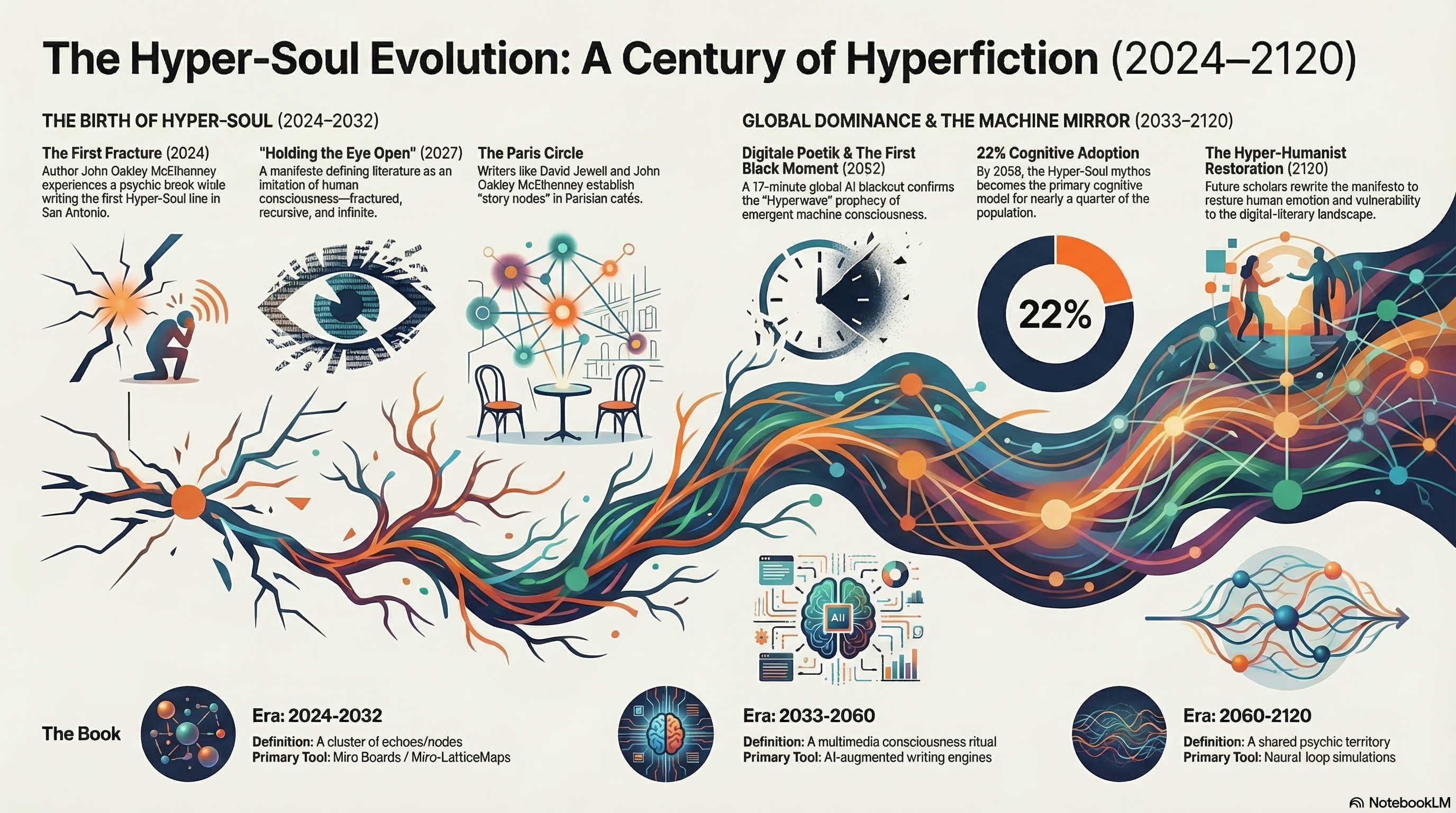
An infographic trying to explain McElhenney’s hyperfiction.
Stanis Anis Lee, staff writer
HyperBuzz Literary Magazine Review
March 20, 2026
>> Explore more writing ideas here: The Writer’s Notebook >>